Python Institute PCEP-30-02최신덤프문제, PCEP-30-02최신버전인기덤프자료
Wiki Article
KoreaDumps PCEP-30-02 최신 PDF 버전 시험 문제집을 무료로 Google Drive에서 다운로드하세요: https://drive.google.com/open?id=1n4ih-w5_mZ-HGUOzlNxjy-b5D5QD3vIL
다른 방식으로 같은 목적을 이룰 수 있다는 점 아세요? 여러분께서는 어떤 방식, 어느 길을 선택하시겠습니까? 많은 분들은Python Institute인증PCEP-30-02시험패스로 자기 일에서 생활에서 한층 업그레이드 되기를 바랍니다. 하지만 모두 다 알고계시는그대로Python Institute인증PCEP-30-02시험은 간단하게 패스할 수 있는 시험이 아닙니다. 많은 분들이Python Institute인증PCEP-30-02시험을 위하여 많은 시간과 정신력을 투자하고 있습니다. 하지만 성공하는 분들은 적습니다.
Python Institute PCEP-30-02 시험요강:
| 주제 | 소개 |
|---|---|
| 주제 1 |
|
| 주제 2 |
|
| 주제 3 |
|
>> Python Institute PCEP-30-02최신 덤프문제 <<
시험준비에 가장 좋은 PCEP-30-02최신 덤프문제 최신 덤프문제
KoreaDumps 에서 제공해드리는 Python Institute PCEP-30-02덤프는 아주 우수한 IT인증덤프자료 사이트입니다. IT업계엘리트한 강사들이 퍼펙트한 Python Institute PCEP-30-02 덤프문제집을 제작하여 디테일한 시험문제와 답으로 여러분이 아주 간단히Python Institute PCEP-30-02시험을 패스할 수 있도록 최선을 다하고 있습니다.
최신 Python Institute PCEP PCEP-30-02 무료샘플문제 (Q13-Q18):
질문 # 13
What is the expected output of the following code?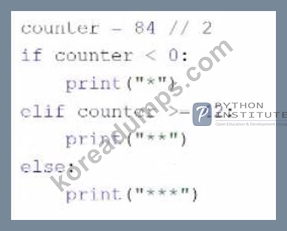
- A. *
- B. * *
- C. * * *
- D. The code produces no output.
정답:B
설명:
Explanation
The code snippet that you have sent is a conditional statement that checks if a variable "counter" is less than 0, greater than or equal to 42, or neither. The code is as follows:
if counter < 0: print("") elif counter >= 42: print("") else: print("") The code starts with checking if the value of "counter" is less than 0. If yes, it prints a single asterisk () to the screen and exits the statement. If no, it checks if the value of "counter" is greater than or equal to 42. If yes, it prints three asterisks () to the screen and exits the statement. If no, it prints two asterisks () to the screen and exits the statement.
The expected output of the code depends on the value of "counter". If the value of "counter" is 10, as shown in the image, the code will print two asterisks (**) to the screen, because 10 is neither less than 0 nor greater than or equal to 42. Therefore, the correct answer is C. * *
질문 # 14
Assuming that the following assignment has been successfully executed:
My_list - [1, 1, 2, 3]
Select the expressions which will not raise any exception.
(Select two expressions.)
- A. my_list[-10]
- B. my_list|my_Li1st | 3| I
- C. my_List- [0:1]
- D. my list [6]
정답:B,C
설명:
Explanation
The code snippet that you have sent is assigning a list of four numbers to a variable called "my_list". The code is as follows:
my_list = [1, 1, 2, 3]
The code creates a list object that contains the elements 1, 1, 2, and 3, and assigns it to the variable "my_list".
The list can be accessed by using the variable name or by using the index of the elements. The index starts from 0 for the first element and goes up to the length of the list minus one for the last element. The index can also be negative, in which case it counts from the end of the list. For example, my_list[0] returns 1, and my_list[-1] returns 3.
The code also allows some operations on the list, such as slicing, concatenation, repetition, and membership.
Slicing is used to get a sublist of the original list by specifying the start and end index. For example, my_list[1:3] returns [1, 2]. Concatenation is used to join two lists together by using the + operator. For example, my_list + [4, 5] returns [1, 1, 2, 3, 4, 5]. Repetition is used to create a new list by repeating the original list a number of times by using the * operator. For example, my_list * 2 returns [1, 1, 2, 3, 1, 1, 2, 3].
Membership is used to check if an element is present in the list by using the in operator. For example, 2 in my_list returns True, and 4 in my_list returns False.
The expressions that you have given are trying to access or manipulate the list in different ways. Some of them are valid, and some of them are invalid and will raise an exception. An exception is an error that occurs when the code cannot be executed properly. The expressions are as follows:
A). my_list[-10]: This expression is trying to access the element at the index -10 of the list. However, the list only has four elements, so the index -10 is out of range. This will raise an IndexError exception and output nothing.
B). my_list|my_Li1st | 3| I: This expression is trying to perform a bitwise OR operation on the list and some other operands. The bitwise OR operation is used to compare the binary representation of two numbers and return a new number that has a 1 in each bit position where either number has a 1. For example, 3 | 1 returns 3, because 3 in binary is 11 and 1 in binary is 01, and 11 | 01 is 11. However, the bitwise OR operation cannot be applied to a list, because a list is not a number. This will raise a TypeError exception and output nothing.
C). my list [6]: This expression is trying to access the element at the index 6 of the list. However, the list only has four elements, so the index 6 is out of range. This will raise an IndexError exception and output nothing.
D). my_List- [0:1]: This expression is trying to perform a subtraction operation on the list and a sublist. The subtraction operation is used to subtract one number from another and return the difference. For example, 3 - 1 returns 2. However, the subtraction operation cannot be applied to a list, because a list is not a number. This will raise a TypeError exception and output nothing.
Only two expressions will not raise any exception. They are:
B). my_list|my_Li1st | 3| I: This expression is not a valid Python code, but it is not an expression that tries to access or manipulate the list. It is just a string of characters that has no meaning. Therefore, it will not raise any exception, but it will also not output anything.
D). my_List- [0:1]: This expression is a valid Python code that uses the slicing operation to get a sublist of the list. The slicing operation does not raise any exception, even if the start or end index is out of range. It will just return an empty list or the closest possible sublist. For example, my_list[0:10] returns [1, 1, 2, 3], and my_list[10:20] returns []. The expression my_List- [0:1] returns the sublist of the list from the index 0 to the index 1, excluding the end index. Therefore, it returns [1]. This expression will not raise any exception, and it will output [1].
Therefore, the correct answers are B. my_list|my_Li1st | 3| I and D. my_List- [0:1].
질문 # 15
Assuming that the following assignment has been successfully executed:
Which of the following expressions evaluate to True? (Select two expressions.)
- A. 1.1 in the_list |1:3 |
- B. the_List.index {"1"} in the_list
- C. len (the list [0:2]} <3
- D. the_list. index {'1'} -- 0
정답:C,D
설명:
The code snippet that you have sent is assigning a list of four values to a variable called "the_list". The code is as follows:
the_list = ['1', 1, 1, 1]
The code creates a list object that contains the values '1', 1, 1, and 1, and assigns it to the variable "the_list".
The list can be accessed by using the variable name or by using the index of the values. The index starts from
0 for the first value and goes up to the length of the list minus one for the last value. The index can also be negative, in which case it counts from the end of the list. For example, the_list[0] returns '1', and the_list[-1] returns 1.
The expressions that you have given are trying to evaluate some conditions on the list and return a boolean value, either True or False. Some of them are valid, and some of them are invalid and will raise an exception.
An exception is an error that occurs when the code cannot be executed properly. The expressions are as follows:
A). the_List.index {"1"} in the_list: This expression is trying to check if the index of the value '1' in the list is also a value in the list. However, this expression is invalid, because it uses curly brackets instead of parentheses to call the index method. The index method is used to return the first occurrence of a value in a list. For example, the_list.index('1') returns 0, because '1' is the first value in the list. However, the_list.index
{"1"} will raise a SyntaxError exception and output nothing.
B). 1.1 in the_list |1:3 |: This expression is trying to check if the value 1.1 is present in a sublist of the list.
However, this expression is invalid, because it uses a vertical bar instead of a colon to specify the start and end index of the sublist. The sublist is obtained by using the slicing operation, which uses square brackets and a colon to get a part of the list. For example, the_list[1:3] returns [1, 1], which is the sublist of the list from the index 1 to the index 3, excluding the end index. However, the_list |1:3 | will raise a SyntaxError exception and output nothing.
C). len (the list [0:2]} <3: This expression is trying to check if the length of a sublist of the list is less than 3.
This expression is valid, because it uses the len function and the slicing operation correctly. The len function is used to return the number of values in a list or a sublist. For example, len(the_list) returns 4, because the list has four values. The slicing operation is used to get a part of the list by using square brackets and a colon. For example, the_list[0:2] returns ['1', 1], which is the sublist of the list from the index 0 to the index 2, excluding the end index. The expression len (the list [0:2]} <3 returns True, because the length of the sublist ['1', 1] is 2, which is less than 3.
D). the_list. index {'1'} - 0: This expression is trying to check if the index of the value '1' in the list is equal to 0. This expression is valid, because it uses the index method and the equality operator correctly. The index method is used to return the first occurrence of a value in a list. For example, the_list.index('1') returns 0, because '1' is the first value in the list. The equality operator is used to compare two values and return True if they are equal, or False if they are not. For example, 0 == 0 returns True, and 0 == 1 returns False. The expression the_list. index {'1'} - 0 returns True, because the index of '1' in the list is 0, and 0 is equal to 0.
Therefore, the correct answers are C. len (the list [0:2]} <3 and D. the_list. index {'1'} - 0.
Reference: Python List Methods - W3Schools5. Data Structures - Python 3.11.5 documentationList methods in Python - GeeksforGeeks
질문 # 16
Assuming that the following assignment has been successfully executed:
My_list - [1, 1, 2, 3]
Select the expressions which will not raise any exception.
(Select two expressions.)
- A. my_list[-10]
- B. my_list|my_Li1st | 3| I
- C. my_List- [0:1]
- D. my list [6]
정답:B,C
설명:
The code snippet that you have sent is assigning a list of four numbers to a variable called "my_list". The code is as follows:
my_list = [1, 1, 2, 3]
The code creates a list object that contains the elements 1, 1, 2, and 3, and assigns it to the variable "my_list".
The list can be accessed by using the variable name or by using the index of the elements. The index starts from 0 for the first element and goes up to the length of the list minus one for the last element. The index can also be negative, in which case it counts from the end of the list. For example, my_list[0] returns 1, and my_list[-1] returns 3.
The code also allows some operations on the list, such as slicing, concatenation, repetition, and membership.
Slicing is used to get a sublist of the original list by specifying the start and end index. For example, my_list[1:
3] returns [1, 2]. Concatenation is used to join two lists together by using the + operator. For example, my_list
+ [4, 5] returns [1, 1, 2, 3, 4, 5]. Repetition is used to create a new list by repeating the original list a number of times by using the * operator. For example, my_list * 2 returns [1, 1, 2, 3, 1, 1, 2, 3]. Membership is used to check if an element is present in the list by using the in operator. For example, 2 in my_list returns True, and 4 in my_list returns False.
The expressions that you have given are trying to access or manipulate the list in different ways. Some of them are valid, and some of them are invalid and will raise an exception. An exception is an error that occurs when the code cannot be executed properly. The expressions are as follows:
A). my_list[-10]: This expression is trying to access the element at the index -10 of the list. However, the list only has four elements, so the index -10 is out of range. This will raise an IndexError exception and output nothing.
B). my_list|my_Li1st | 3| I: This expression is trying to perform a bitwise OR operation on the list and some other operands. The bitwise OR operation is used to compare the binary representation of two numbers and return a new number that has a 1 in each bit position where either number has a 1. For example, 3 | 1 returns
3, because 3 in binary is 11 and 1 in binary is 01, and 11 | 01 is 11. However, the bitwise OR operation cannot be applied to a list, because a list is not a number. This will raise a TypeError exception and output nothing.
C). my list [6]: This expression is trying to access the element at the index 6 of the list. However, the list only has four elements, so the index 6 is out of range. This will raise an IndexError exception and output nothing.
D). my_List- [0:1]: This expression is trying to perform a subtraction operation on the list and a sublist. The subtraction operation is used to subtract one number from another and return the difference. For example, 3 -
1 returns 2. However, the subtraction operation cannot be applied to a list, because a list is not a number. This will raise a TypeError exception and output nothing.
Only two expressions will not raise any exception. They are:
B). my_list|my_Li1st | 3| I: This expression is not a valid Python code, but it is not an expression that tries to access or manipulate the list. It is just a string of characters that has no meaning. Therefore, it will not raise any exception, but it will also not output anything.
D). my_List- [0:1]: This expression is a valid Python code that uses the slicing operation to get a sublist of the list. The slicing operation does not raise any exception, even if the start or end index is out of range. It will just return an empty list or the closest possible sublist. For example, my_list[0:10] returns [1, 1, 2, 3], and my_list[10:20] returns []. The expression my_List- [0:1] returns the sublist of the list from the index 0 to the index 1, excluding the end index. Therefore, it returns [1]. This expression will not raise any exception, and it will output [1].
Therefore, the correct answers are B. my_list|my_Li1st | 3| I and D. my_List- [0:1].
Reference: [Python Institute - Entry-Level Python Programmer Certification]
질문 # 17
Which of the following are the names of Python passing argument styles?
(Select two answers.)
- A. keyword
- B. indicatory
- C. positional
- D. reference
정답:A,C
설명:
Explanation
Keyword arguments are arguments that are specified by using the name of the parameter, followed by an equal sign and the value of the argument. For example, print (sep='-', end='!') is a function call with keyword arguments. Keyword arguments can be used to pass arguments in any order, and to provide default values for some arguments1.
Positional arguments are arguments that are passed in the same order as the parameters of the function definition. For example, print ('Hello', 'World') is a function call with positional arguments. Positional arguments must be passed before any keyword arguments, and they must match the number and type of the parameters of the function2.
References: 1: 5 Types of Arguments in Python Function Definitions | Built In 2: python - What's the pythonic way to pass arguments between functions ...
질문 # 18
......
성공으로 향하는 길에는 많은 방법과 방식이 있습니다. Python Institute인증 PCEP-30-02시험을 패스하는 길에는KoreaDumps의Python Institute인증 PCEP-30-02덤프가 있습니다. KoreaDumps의Python Institute인증 PCEP-30-02덤프는 실제시험 출제방향에 초점을 두어 연구제작한 시험준비공부자료로서 높은 시험적중율과 시험패스율을 자랑합니다.국제적으로 승인해주는 IT자격증을 취득하시면 취직 혹은 승진이 쉬워집니다.
PCEP-30-02최신버전 인기 덤프자료: https://www.koreadumps.com/PCEP-30-02_exam-braindumps.html
- 적중율 좋은 PCEP-30-02최신 덤프문제 덤프자료 PCEP - Certified Entry-Level Python Programmer 인증시험자료 ???? 지금「 www.exampassdump.com 」을(를) 열고 무료 다운로드를 위해▷ PCEP-30-02 ◁를 검색하십시오PCEP-30-02최고품질 덤프데모 다운
- 최신 PCEP-30-02최신 덤프문제 시험덤프자료 ???? { www.itdumpskr.com }웹사이트에서➡ PCEP-30-02 ️⬅️를 열고 검색하여 무료 다운로드PCEP-30-02최신버전 시험덤프자료
- PCEP-30-02덤프샘플 다운 ⚓ PCEP-30-02최신 업데이트 덤프문제 ???? PCEP-30-02합격보장 가능 시험대비자료 ???? 오픈 웹 사이트➡ www.itdumpskr.com ️⬅️검색☀ PCEP-30-02 ️☀️무료 다운로드PCEP-30-02자격증참고서
- PCEP-30-02시험대비 인증공부 ???? PCEP-30-02시험대비 인증공부 ???? PCEP-30-02시험합격 ???? 무료로 다운로드하려면➤ www.itdumpskr.com ⮘로 이동하여“ PCEP-30-02 ”를 검색하십시오PCEP-30-02시험대비덤프
- PCEP-30-02자격증참고서 ???? PCEP-30-02최고품질 덤프데모 다운 ???? PCEP-30-02시험대비 최신 덤프 ???? ⮆ www.passtip.net ⮄웹사이트에서《 PCEP-30-02 》를 열고 검색하여 무료 다운로드PCEP-30-02인증덤프공부문제
- PCEP-30-02자격증참고서 ???? PCEP-30-02시험대비 인증공부 ???? PCEP-30-02시험합격 ???? 지금「 www.itdumpskr.com 」에서➤ PCEP-30-02 ⮘를 검색하고 무료로 다운로드하세요PCEP-30-02시험패스 가능한 공부자료
- PCEP-30-02인증덤프공부문제 ???? PCEP-30-02시험대비 최신 덤프 ???? PCEP-30-02덤프샘플 다운 ???? 지금《 www.koreadumps.com 》을(를) 열고 무료 다운로드를 위해“ PCEP-30-02 ”를 검색하십시오PCEP-30-02최신 업데이트 덤프자료
- PCEP-30-02최신 덤프문제 100% 합격 보장 가능한 덤프문제 ???? ➠ PCEP-30-02 ????를 무료로 다운로드하려면“ www.itdumpskr.com ”웹사이트를 입력하세요PCEP-30-02시험패스 가능한 공부자료
- PCEP-30-02시험패스 가능한 공부자료 ???? PCEP-30-02최고품질 덤프데모 다운 ???? PCEP-30-02최신 업데이트 덤프자료 ???? ➤ www.passtip.net ⮘에서 검색만 하면▛ PCEP-30-02 ▟를 무료로 다운로드할 수 있습니다PCEP-30-02시험대비 인증공부
- PCEP-30-02시험패스 가능한 공부자료 ???? PCEP-30-02최신 업데이트 덤프문제 ???? PCEP-30-02최신버전 시험덤프자료 ???? ➥ www.itdumpskr.com ????에서☀ PCEP-30-02 ️☀️를 검색하고 무료로 다운로드하세요PCEP-30-02시험패스 가능한 공부자료
- 시험대비 PCEP-30-02최신 덤프문제 덤프 샘플문제 다운 ☢ 「 www.itdumpskr.com 」을(를) 열고“ PCEP-30-02 ”를 검색하여 시험 자료를 무료로 다운로드하십시오PCEP-30-02합격보장 가능 시험대비자료
- adrianaccgh037220.dekaronwiki.com, www.stes.tyc.edu.tw, www.stes.tyc.edu.tw, safatxhc883241.blogginaway.com, adrianasowb683344.activoblog.com, atozbookmarkc.com, marvinjwwc050480.blogdal.com, kallumzstl990883.prublogger.com, ihannamwnq702596.blazingblog.com, lexielrbb485624.bloggazza.com, Disposable vapes
2026 KoreaDumps 최신 PCEP-30-02 PDF 버전 시험 문제집과 PCEP-30-02 시험 문제 및 답변 무료 공유: https://drive.google.com/open?id=1n4ih-w5_mZ-HGUOzlNxjy-b5D5QD3vIL
Report this wiki page